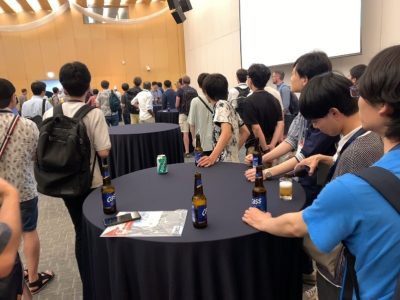
We are a research group in experimental physics at Kyoto University led by Prof. Kenji Ishida. Our research focuses on various phenomena in strongly correlated materials where strong electron–electron interactions lead to emerging physical properties. These phenomena manifest themselves at temperatures much lower than the ambient one, conditions in which materials are dominated by quantum physics and statistical mechanics. Our main interest involves phenomena such as superconductivity, strong magnetism, and spin frustration effects.
0. NMR (Nuclear Magnetic Resonance)
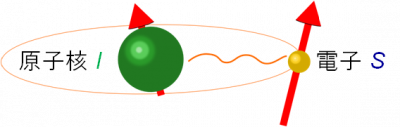
NMR is a powerful measurement tool that allows us to measure electronic and magnetic states on the microscopic scale by using nuclear spins. With this technique, we study the electronic states of a wide range of materials ranging from superconductors to magnetic materials.
1. UTe2 : Multiple superconducting states with spin degrees of freedom
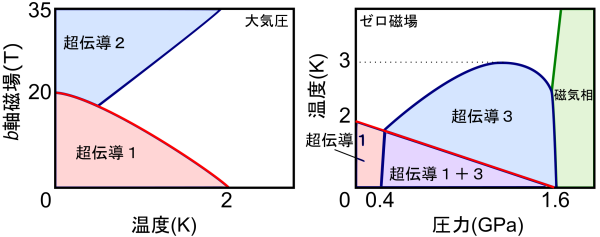
A spin-triplet superconductor UTe2 was discovered in 2018. It is thought that the spin degree of freedom of S=1 exists
even in the superconducting state based on the experimental observation of multiple superconducting states against magnetic field and pressure. We observed a new phenomenon, superconducting spin polarization, using spin degrees of freedom from NMR measurements.
2. CeRh2As2 : Multiple superconducting phases due to sublattice degrees of freedom
A superconductor CeRh2As2 was discovered in 2021.
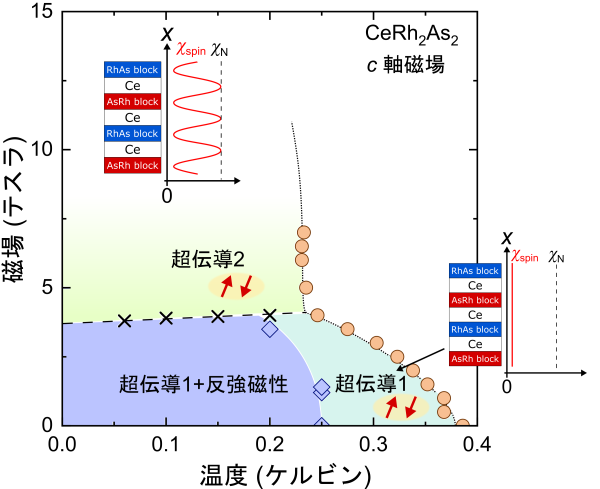
It is expected to be quite strong against magnetic fields, and a pair density wave state (odd-parity spin-singlet state) will be realized in high magnetic field region.
From NMR measurements, we observed
(1 ) a result suggesting spatial modulation of the spin susceptibility
(2 ) discovery of the correlation between the antiferromagnetic order and superconductivity
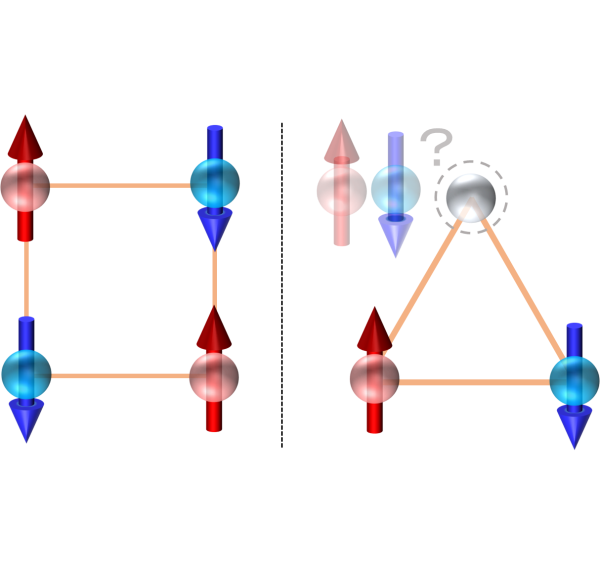
3. Charge-neutral particles appearing in the frustrated magnet YbCuS2
Frustration is a phenomenon in which spins (small magnets) cannot align well and become unstable.
Frustrated magnets are expected to
suppress magnetic phase transition and behave differently from ordinary magnets. In our lab., we discovered that YbCuS2, in which Yb atoms have a zigzag chain, shows metal-like behavior at low temperatures despite being an insulator. This suggests the existence of charge-neutral particles.
4. Electronic states appearing in topological line node materials
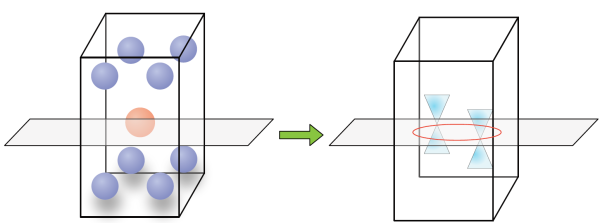
A material whose geometry (atomic arrangement) in real space induces a non-trivial topology in wavenumber space (electron motion) is called a topological material.
In our lab., we are studying topological line node metallic superconductor CaSb 2 and inverse perovskite superconductor Sr3- xSnO.
We aim to elucidate the electronic states in topological materials and their relationships with superconductivity and other physical phenomena.
5. Close relationship between ferromagnetic fluctuation and superconductivity in ferromagnetic superconductor UCoGe
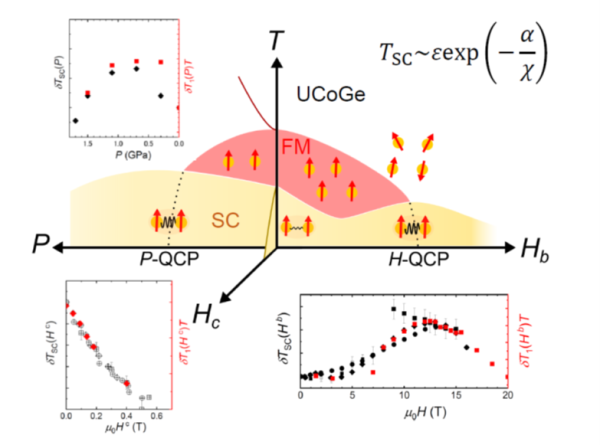
In BCS superconductors, a relational expression holds between the superconducting transition temperature TSC and lattice vibration. We clarified that a universal relational expression holds between TSC and ferromagnetic fluctuations in the ferromagnetic superconductor UCoGe as well, from NMR measurements under magnetic field angle, magnetic field, and pressure. In other words, we clarified the relationship between superconductivity and ferromagnetic fluctuations from a quantitative point of view and pointed out the possibility of spin-triplet superconductivity due to ferromagnetic fluctuations.
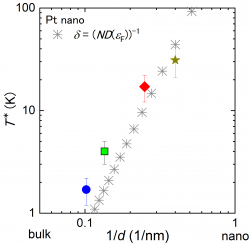
6. Quantum size effect in nanoparticles
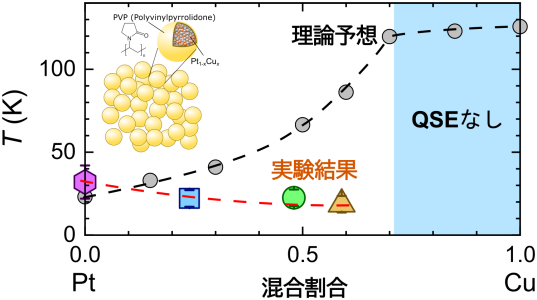
Nanoparticles can be expected to show unique properties, such as magnetism, metal–insulator transitions, that are due to the discrete nature of the quantum energy levels, which are different from bulk materials. We study quantum size effects in materials such as Pt nanoparticles with NMR measurements.
7. Magnetism and quantum critical phenomena
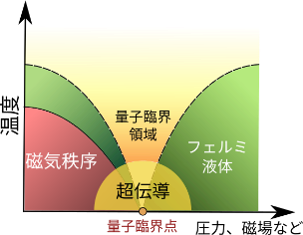
Several interesting magnetic and superconducting states appear near the quantum critical point of materials. Our research aims to investigate the physical properties near quantum critical points aided by pressure and strong electric and magnetic fields.
